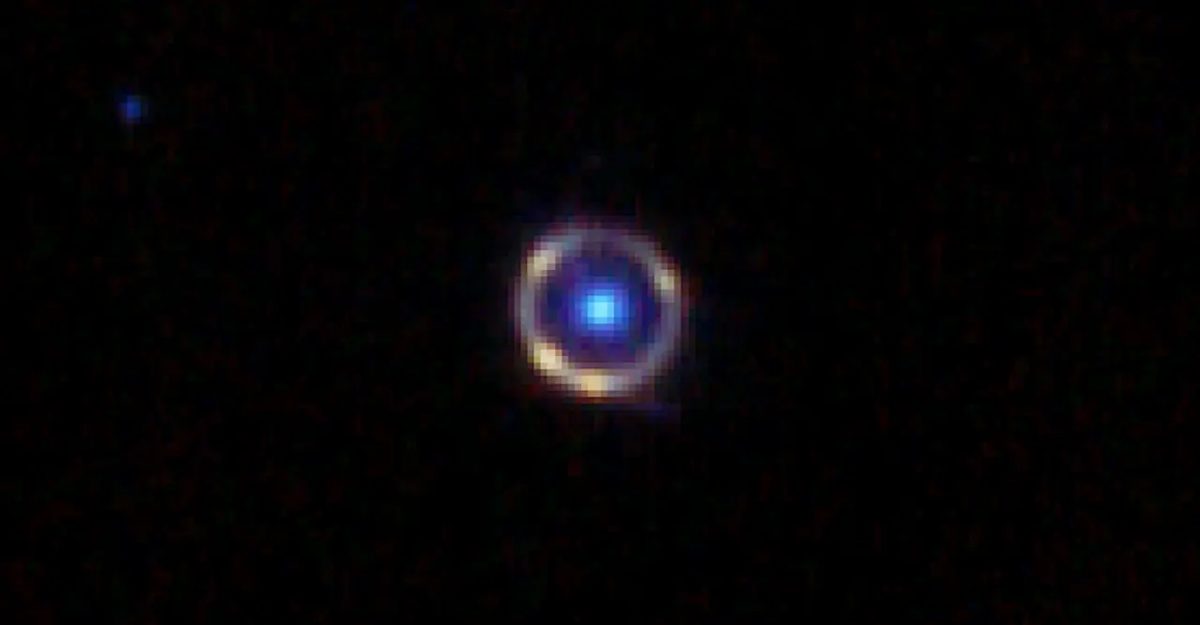
Public astronomy datasets are rarely glamorous. They are usually buried under layers of proprietary pipelines, complex calibration files, and strict access protocols that gatekeep deep space observations. Yet, hidden within the vast archives of the James Webb Space Telescope (JWST) lies a trove of raw data waiting for someone with the patience and skill to look. Enter Spaceguy44.
He is not a professional astronomer at NASA. He is a graduate student in astronomy who goes by that handle on Reddit. But he knows where the Miri mid-infrared instrument data lives. And he knew that this specific dataset held something extraordinary.
The result is an almost flawless Einstein ring.
The Science of the Bend
To understand why this image matters, you have to understand the geometry of the universe. An Einstein ring is not a physical object. It is an optical illusion created by gravity.
When a massive object sits directly between Earth and a distant light source, its gravity warps the fabric of spacetime. Light from the background source bends around the foreground mass. If the alignment is perfect, the light forms a complete circle.
The galaxy in question is SPT-S J041839-4751.8, or JO418. It sits roughly 12 billion light-years away. That is close to the edge of the observable universe. We are seeing it as it existed when the cosmos was still a teenager.
But we don’t see JO418 directly. We see its light distorted by a galaxy lying in the foreground. This intervening galaxy is massive. It acts as a cosmic lens. The blue light visible at the very center of the ring comes from that closer, lensing galaxy. The ring itself is the smeared-out image of JO418.
Why Mid-Infrared Changes Everything
Most famous Einstein ring images come from Hubble or early Webb observations in visible or near-infrared light. They show stars. They show stellar nurseries.
This image is different. It uses mid-infrared data from MIRI.
Why does this matter? Mid-infrared light penetrates dust. It sees through the cosmic fog that blocks visible light. It reveals the heat signatures of forming stars and the structure of galaxies in ways that optical telescopes simply cannot.
Spaceguy44 took the raw MIRI data. He processed it. He calibrated it. He didn’t just release a pretty picture; he demonstrated that amateur scientists can produce professional-grade analysis using public JWST archives.
The Rarity of Perfection
Perfect Einstein rings are rare. They require a precise alignment. The foreground lens must be nearly perfectly centered on the background source. Any slight offset results in arcs, not a full circle.
Most images we see are partial arcs. This one is complete. The symmetry is striking. It serves as a natural laboratory for studying dark matter distribution in the lensing galaxy. It helps astronomers measure the mass of the foreground object with high precision.
But beyond the physics, there is the human element. The dataset was public. The tool was available. The person just had to ask the right questions and execute the science correctly.
What This Means for Citizen Science
For years, the narrative has been that space science is exclusively for those with institutional backing. You need a telescope. You need


Stop waiting for the algorithm to find you.
You need to pull the content directly into your pocket.
If you want real-time updates on breakthroughs without sifting through a noisy feed, Futura offers two direct lines of communication.
WhatsApp Updates for Instant Alerts
WhatsApp is no longer just for family group chats about dinner plans.
It is a legitimate distribution channel for niche science journalism.
Following Futura on WhatsApp means you get push notifications.
No scrolling.
No hunting.
Just the latest headlines from science and tech dropped straight into your chat list.
This is how you stay ahead of the curve when a major discovery drops at 9 AM on a Tuesday.
The key here is immediacy. You don’t wait for a newsletter digest or a social media scroll. The news comes to you.
Google News: Curated & Personalized
Not everyone wants a chat app notification every five minutes.
If you prefer a cleaner, aggregated approach, the Google News integration is your move.
This isn’t just a random feed.
Google’s algorithm surfaces Futura’s coverage based on your interests.
When a new study on quantum computing or a shift in space exploration occurs, it surfaces in your personalized stream.
It is passive consumption.
High signal-to-noise ratio.
Why This Mix Matters
Most science news is buried under clickbait or corporate press releases.
Following Futura directly cuts through that.
- WhatsApp gives you speed.
- Google News gives you context and curation.
Use both.
Or pick the one that fits your daily rhythm.
The goal is simple.
Don’t miss the next big shift in how we understand the universe.
Or how we build the future.
The tech changes fast.
Your attention span should keep up.